Deer Season Is Here. Do You Know Which Insurance Claim You're Filing?
Mississippi ranks 8th in the nation for animal-collision claims. Whether you hit the deer or swerve to avoid it makes all the difference in how your insurer handles the claim.
It's a Tuesday Evening on a Two-Lane Road
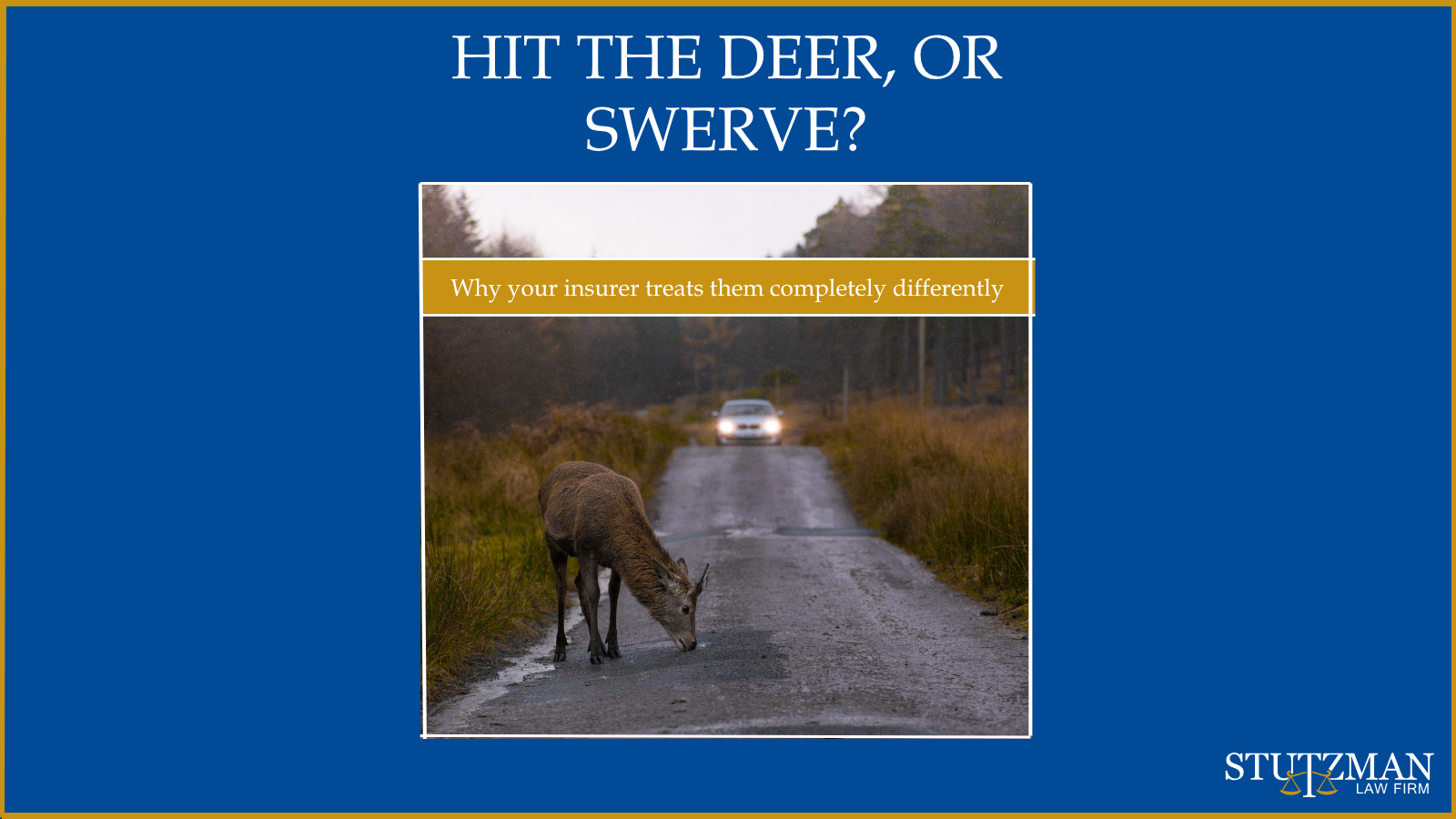
The sun is already setting behind the tree line. A deer steps out of the woods without warning. Some drivers hit it. Some drivers swerve, clip a guardrail, and end up with a much bigger claim — and a much bigger argument with their insurance company about who's at fault. Both drivers encountered a deer in the road, but only one of them has a simple claim.
Why This Matters More in Mississippi Than Most Places
Mississippi isn't the first state people picture when they think about deer-vehicle collisions. Wisconsin and the northern forest states usually come to mind first. But recent insurance industry data tells a different story. Mississippi currently ranks 8th in the nation for the likelihood of an animal-collision insurance claim. That places the odds at around 1 in 77 for a Mississippi driver in a given year, compared to a national average of roughly 1 in 139.
That's not a coincidence. Central and south Mississippi's mix of pine forest, soybean fields, and four-lane highways cutting through creek bottoms creates exactly the kind of edge habitat where deer move — especially at dawn and dusk.
Timing makes it worse. Archery deer season opens October 1 across most of Mississippi (October 15 in the southeast part of the state), and deer movement increases as hunting pressure and the fall rut both ramp up. Nationally, insurers report that October through December accounts for roughly 41% of all animal-collision claims filed in a full year, with November being the single most dangerous month.
Think you're safe because you're driving in the Jackson metro area? Think again. I've recently seen deer on Flowood Drive and a few other roads in the metro area.
What Actually Happens to Your Insurance Claim?
Here's what catches people off guard, and it comes down to one question: did you hit the deer, or did you hit something else while trying to avoid it?
Is hitting a deer covered by comprehensive or collision insurance in Mississippi?
If you strike a deer directly, that's a comprehensive coverage claim. Comprehensive is the part of your policy that covers damage from events outside your control — weather, falling objects, theft, and animal strikes. Critically, a comprehensive claim for hitting a deer is generally not treated as an "at-fault" accident, because there's no meaningful sense in which you caused it.
Here's the catch a lot of drivers don't realize until it's too late: comprehensive coverage is optional. If you're carrying only Mississippi's state-minimum liability coverage with no comprehensive coverage on your policy, hitting a deer means you pay for the damage to your own vehicle out of pocket. It's worth checking your declarations page before deer season gets into full swing — not after.
What if I swerve to avoid a deer and hit something else?
This is where it gets more complicated, and where an otherwise simple deer encounter can turn into a real liability dispute. If you swerve to avoid a deer and instead run off the road, hit a guardrail or a tree, overturn your vehicle, or strike another car, that damage is a collision claim — not comprehensive. And a collision claim raises the question every wreck raises: who was at fault?
The deer isn't a party to your insurance claim, so the question becomes whether you drove the way a reasonable, careful driver would have in the same situation. Mississippi doesn't have a special "sudden emergency" rule for this anymore. The Mississippi Supreme Court did away with that separate rule in 1980 (Knapp v. Stanford, 392 So. 2d 196 (Miss. 1980)), and today a deer jumping out is simply one of the circumstances a jury weighs in deciding whether you acted reasonably.
That cuts both ways. In one Mississippi case, a driver swerved to miss an animal that darted into the road, left the highway, and hit a tree. The jury decided she acted reasonably and that the animal alone caused the wreck, and the Mississippi Supreme Court let that verdict stand (Upchurch v. Rotenberry, 761 So. 2d 199 (Miss. 2000)). But a driver who was going too fast for the conditions, or who jerked the wheel into oncoming traffic, can be found at fault for the crash — even though a deer is what started it.
If fault is shared, Mississippi's pure comparative negligence rule (Miss. Code Ann. § 11-7-15) decides how the damages get divided. Unlike some states, Mississippi doesn't prevent you from recovering anything because you were more than half at fault — your damages are simply reduced by your share. Either way, that's a very different, and often more contentious, process than a straightforward comprehensive claim for hitting the deer itself.
Can I Hold Anyone Responsible for the Deer?
Most likely not. Mississippi courts have refused to hold landowners liable for wild animals living in a state of nature on their property. The reasoning is that wildlife is managed by the state, not the landowner (Christmas v. Exxon Mobil Corp., 138 So. 3d 123 (Miss. 2014)), and no Mississippi appellate court has held a landowner liable for a wild deer that wandered onto a road. Claims that the state should have posted more deer-crossing signs or fenced a highway generally run into immunity under the Mississippi Tort Claims Act, Miss. Code Ann. § 11-46-9.
Livestock is a different story. A cow or horse on the highway has an owner, and Mississippi law can hold that owner responsible when the animal got onto the road through the owner's negligence (Miss. Code Ann. § 69-13-111). But the injured driver has to prove the owner was actually careless — the animal simply being loose isn't enough (Ladnier v. Hester, 98 So. 3d 1025 (Miss. 2012)). A 2020 amendment also removed older statutory language that had previously put the burden on the owner. If you read an older article saying the owner has to prove he wasn't negligent, that information is out of date.
What if Another Car Ran Me Off the Road?
If an unidentified driver forces you off the road, you might assume your uninsured motorist coverage will step in. In Mississippi, it usually won't — unless that other vehicle actually made contact with you or your car. The UM statute requires "actual physical contact" when the other driver can't be identified (Miss. Code Ann. § 83-11-103), and Mississippi courts enforce that strictly, even when an eyewitness backs up your story (Anderson v. State Farm, 555 So. 2d 733 (Miss. 1990); Mitchell v. USAA, 831 So. 2d 1144 (Miss. 2002)). The Mississippi Court of Appeals reaffirmed the rule as recently as March 2026. And a deer isn't a motor vehicle at all, so uninsured motorist coverage isn't the path for a deer strike.
Will Hitting a Deer Raise My Insurance Rates?
Generally, no — or at least not the way an at-fault collision would. Because a direct deer strike is a comprehensive claim rather than an at-fault accident, most insurers don't apply the same kind of surcharge they would for a wreck you caused. Rates can still be affected by a pattern of claims over time, and every insurer's underwriting is a little different, so this is a good conversation to have with your agent rather than assuming.
What Should I Actually Do if I Hit a Deer — or Swerve to Avoid One?
The best outcome starts before the deer is even in the road. If you're driving at dawn or dusk this fall, especially anywhere lined with woods or fields, slow down and be prepared to brake. If a deer does appear:
- Brake firmly and stay in your lane. Don't jerk the wheel to dodge it. A collision with a 150-pound deer, while unpleasant, is almost always safer and less costly than losing control of your vehicle.
- Pull off the road safely once the immediate danger has passed, and turn on your hazard lights.
- Don't assume the deer is gone. Deer often travel in groups — if one crossed, others may follow.
- Call the police if there's significant damage or any injury. A police report creates an official record that matters when you file your claim.
- Document everything. Photograph the damage to your vehicle, the location, any skid marks, and the deer if it's still in the roadway.
- Contact your insurance company promptly. If you have comprehensive coverage, report the claim. If you swerved and hit something else, be precise about the sequence of events — the distinction between a comprehensive and a collision claim can affect both your deductible and your rates.
The Takeaway
A deer in the road is one of those situations where the split-second decision you make — and the coverage you bought months ago — both matter enormously. If you hit the deer, a comprehensive claim is usually straightforward. If you swerved and the situation got complicated, you may be dealing with fault questions, comparative negligence, and a more adversarial claims process.
If you've been in a wreck involving a deer or an evasive maneuver and the insurance company is pushing back, I'm happy to talk through your situation at no charge. Call us at (769) 208-5683.
This post is for general educational purposes only and is not legal advice. Reading it does not create an attorney-client relationship between you and The Stutzman Law Firm. Every accident and every insurance policy is different, and the outcome of any claim depends on its own specific facts. If you have questions about a specific situation, consult a licensed Mississippi attorney.
Explore Topics
Written by
Ronald E. Stutzman, Jr.
Content creator and writer sharing insights and stories.