What Mississippi Gig Drivers Need to Know About Car Insurance
Driving for Spark, DoorDash, Uber, or Lyft? The moment you log on to the app, your personal auto policy may stop covering you — and Mississippi law is silent on delivery drivers.
The Question That Decides Whether Your Policy Pays
You finish a Walmart Spark run in Pearl on a Thursday night. On the way to the next pickup, somebody runs a light and hits you. The other driver has no insurance. You call your own company, because that's what uninsured motorist coverage is for. The adjuster asks one question: "Were you working for an app at the time?"
Your answer may decide whether your own policy pays a dime.
Thousands of Mississippians now drive for Uber, Lyft, Spark, DoorDash, Instacart, or Uber Eats. Some do it full time. Many do it a few nights a week to cover a car note or a grocery bill. Almost none of them have read the page of their auto policy that decides what happens when they're hit while working.
In the coverage disputes I handle, this is where the trouble starts: not with the wreck, but with a sentence buried in the policy that no one noticed.
Does My Personal Car Insurance Cover Me While I'm Driving for Uber or Lyft in Mississippi?
Maybe not — and the Mississippi Legislature said so.
In 2016, Mississippi passed a law regulating what it calls "transportation network companies." That's the statute's name for Uber, Lyft, and any company that uses an app to connect a driver in a personal car with a paying passenger. You can find the law at Miss. Code Ann. § 77-8-1 and the sections that follow.
One section of that law, § 77-8-19, speaks directly to your personal auto insurer. It says the insurer "may exclude any and all coverage afforded under the policy" for any loss "that occurs while a driver is logged on to a transportation network company's digital network or while a driver provides a prearranged ride." Then it lists what can be excluded: liability coverage, uninsured and underinsured motorist coverage, medical payments, comprehensive, and collision.
Read that list again. Uninsured motorist coverage is on it. The coverage you bought to protect yourself from the driver with no insurance can be switched off by your own policy the moment you go online — if your policy says so. Not every policy does. But the law permits it, and many standard policies now contain some version of this exclusion.
So Who Covers an Uber or Lyft Driver While the App Is On?
The rideshare company, by law.
This same set of statutes, at § 77-8-15, requires the company or the driver to carry insurance during two specific time periods:
- While logged on and waiting for a ride request: at least $50,000 per person and $100,000 per accident in bodily injury liability, $25,000 in property damage, and uninsured motorist coverage to the extent Mississippi's UM statute requires.
- Once the driver accepts a ride and until the last passenger exits: the floor rises to $1,000,000 in liability, plus uninsured motorist coverage as required by Miss. Code Ann. § 83-11-101.
This is a two-stage design. Your personal insurer can step out while you're working, and the rideshare company's policy is supposed to step in. If you drive for Uber or Lyft, that company policy protects you while you are on the clock. You should know what it says.
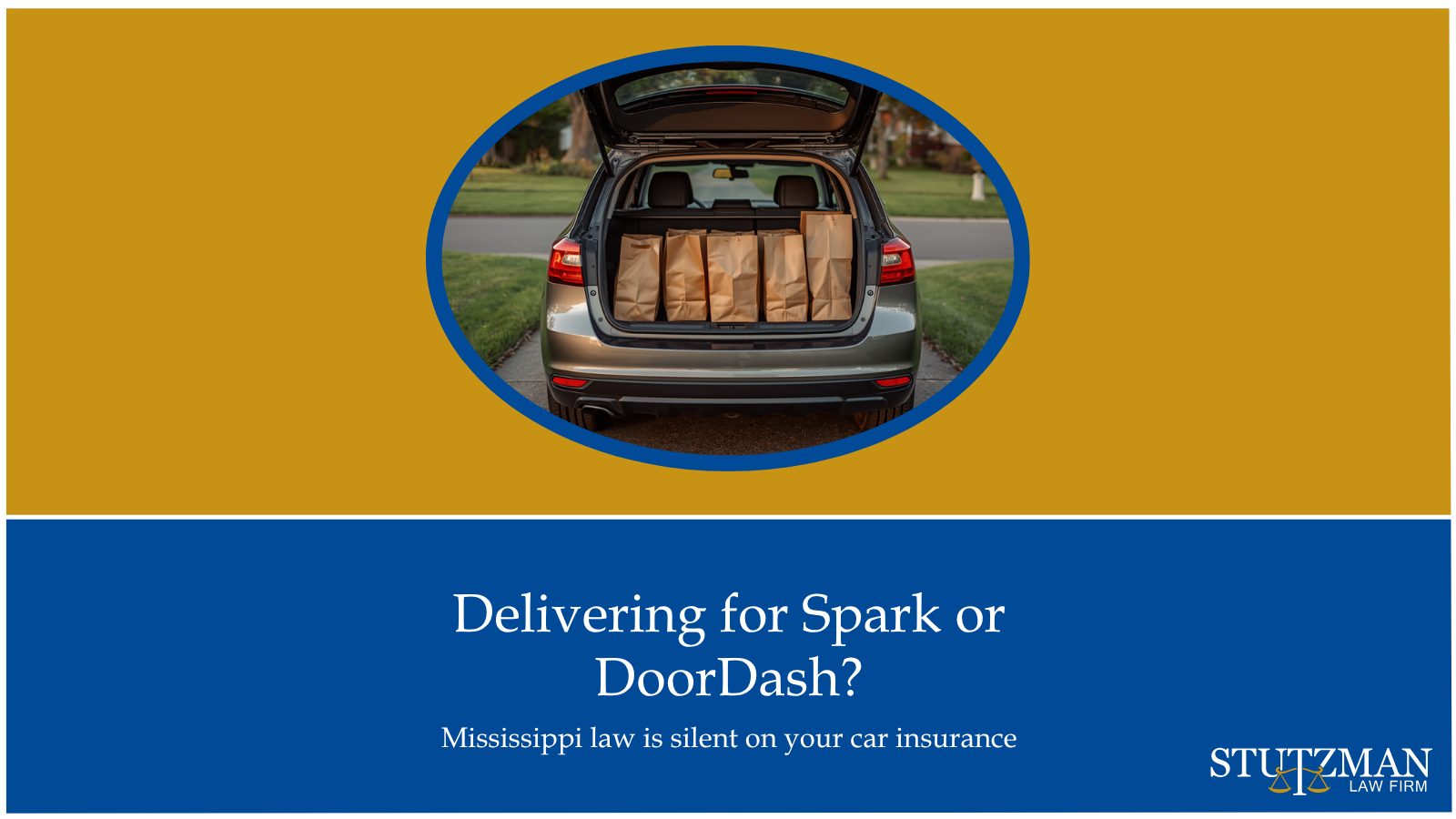
What If I Deliver Groceries or Food Instead of People?
This is where Mississippi law is silent — and where I think most gig drivers are exposed without knowing it.
The 2016 statute is written entirely around passengers. Its definitions talk about "riders," about connecting riders to drivers, and about a "prearranged ride" that ends "when the last requesting rider departs from the personal vehicle." A driver carrying a bag of groceries or a pizza is not carrying a rider. On its face, the rideshare law does not describe what a Spark or DoorDash driver does.
Mississippi has not passed a separate law for delivery drivers. Some other states have; ours has not. There is no statute telling your personal insurer it can exclude you while you deliver, and no statute telling Walmart, DoorDash, or Instacart what insurance they must carry for you.
Where does this leave a delivery driver? The analysis comes down to two documents:
- Your own auto policy. Many policies contain exclusions written more broadly than the rideshare statute, using phrases like "public or livery conveyance," "carrying persons or property for a fee," or simply "delivery." Whether one of those phrases reaches what you were doing when you were hit depends on the exact words and the exact facts.
- The delivery company's driver agreement, which may or may not provide any coverage at all, and may or may not include uninsured motorist protection.
No Mississippi appellate court has yet decided whether a delivery driver's personal uninsured motorist coverage survives one of these exclusions. What I can tell you is that it's an open question — and an open question is a bad thing to discover for the first time from a hospital bed.
What Should a Mississippi Gig Driver Do This Week?
Three things, in order.
1. Read your policy's exclusions. Not the declarations page with the dollar amounts — the exclusions. Look for any language about ridesharing, transportation network companies, delivery, livery, public conveyance, or carrying persons or property for a fee. If you can't find your policy, your insurer will send it.
2. Ask your agent in writing whether you are covered while driving for your specific app, and whether you need a rideshare or delivery endorsement. Several insurers sell an endorsement that covers this gap for a modest premium. Get the answer by email, not over the phone. If a dispute ever comes, you'll want to show exactly what you asked and exactly what you were told.
3. Get the app company's insurance terms. For Uber and Lyft, the statute sets the floor and the company publishes its coverage. For Spark, DoorDash, and the rest, read the driver agreement and find out whether any coverage is available if someone else causes the wreck.
One more thing I tell every client who drives for a living: tell your insurer what you do before a wreck, not after. An insurer that learns about your work in a claim call is in a very different posture than one you told up front.
The Takeaway
If you carry passengers for an app in Mississippi, the law lets your own insurer drop your coverage while you work and makes the rideshare company carry coverage instead. If you deliver goods, the law is silent, your policy's wording controls, and nobody has told the delivery company it has to protect you.
Either way, the fix is cheap and takes an afternoon: read the exclusions, ask the question in writing, and know what the company's policy actually says.
If you were in a wreck while working for a delivery or rideshare app and you're getting pushback from an insurance company, I'm happy to talk through your situation at no charge. Call us at (769) 208-5683.
This post is for general educational purposes only and is not legal advice. Reading it does not create an attorney-client relationship between you and The Stutzman Law Firm. Insurance policies differ, facts differ, and the law changes. If you have a question about your own coverage or a wreck you were in, consult a licensed Mississippi attorney about your specific circumstances.
Explore Topics
Written by
Ronald E. Stutzman, Jr.
Content creator and writer sharing insights and stories.