Halloween Safety in Mississippi: Help Drivers See Your Kids Before It's Too Late
On Halloween evening, children ages 4 to 8 face roughly 10 times their usual risk of being killed while walking. A few dollars of reflective tape and a glow stick can change how that moment ends.
A Moment That Happens Every Halloween
It's 6:45 on Halloween night in a Flowood neighborhood. The porch lights are on, and the streets are full. A five-year-old in a black cat costume lets go of her mom's hand and runs toward the next house, which happens to be across the street. A driver coming around the curve is going 25 miles an hour, maybe a little more. He's watching for kids. He just doesn't see her.
Every parent's stomach drops reading that. The good news is that a few dollars and a few minutes of planning before Halloween can change how that moment ends.
Why Is Halloween So Dangerous for Kids on Foot?
It isn't just a feeling. A study published in JAMA Pediatrics in 2018 looked at 42 years of U.S. fatal crash data, from 1975 through 2016. The researchers compared Halloween evening to the same evening one week before and one week after. The risk of pedestrian deaths was about 43% higher on Halloween. For children ages 4 to 8, it was roughly 10 times higher.
The most dangerous window was 5 to 8 p.m. — prime trick-or-treating time.
Think about what's happening that night. You have more small children on foot than any other evening of the year. They're excited, they're running, and they're focused on candy, not cars. Many of them are wearing masks that restrict their peripheral vision. And according to NHTSA, nearly half of all crash deaths on Halloween night in 2023 were alcohol-related, so some of the drivers on the road are impaired.
Why It Matters More Here in Central Mississippi
Here, the sun sets around 6 p.m. on October 31. In much of the Jackson metro, trick-or-treating doesn't hit full swing until after supper. So for most families, the candy route happens in the dark or near-dark.
A lot of our neighborhoods don't have sidewalks, either. In parts of Rankin and Madison counties, kids walk along the edge of the road or cut across yards and driveways. Add parked cars lining both sides of a street, and you've got children stepping out from behind vehicles where a driver has no line of sight until the last second.
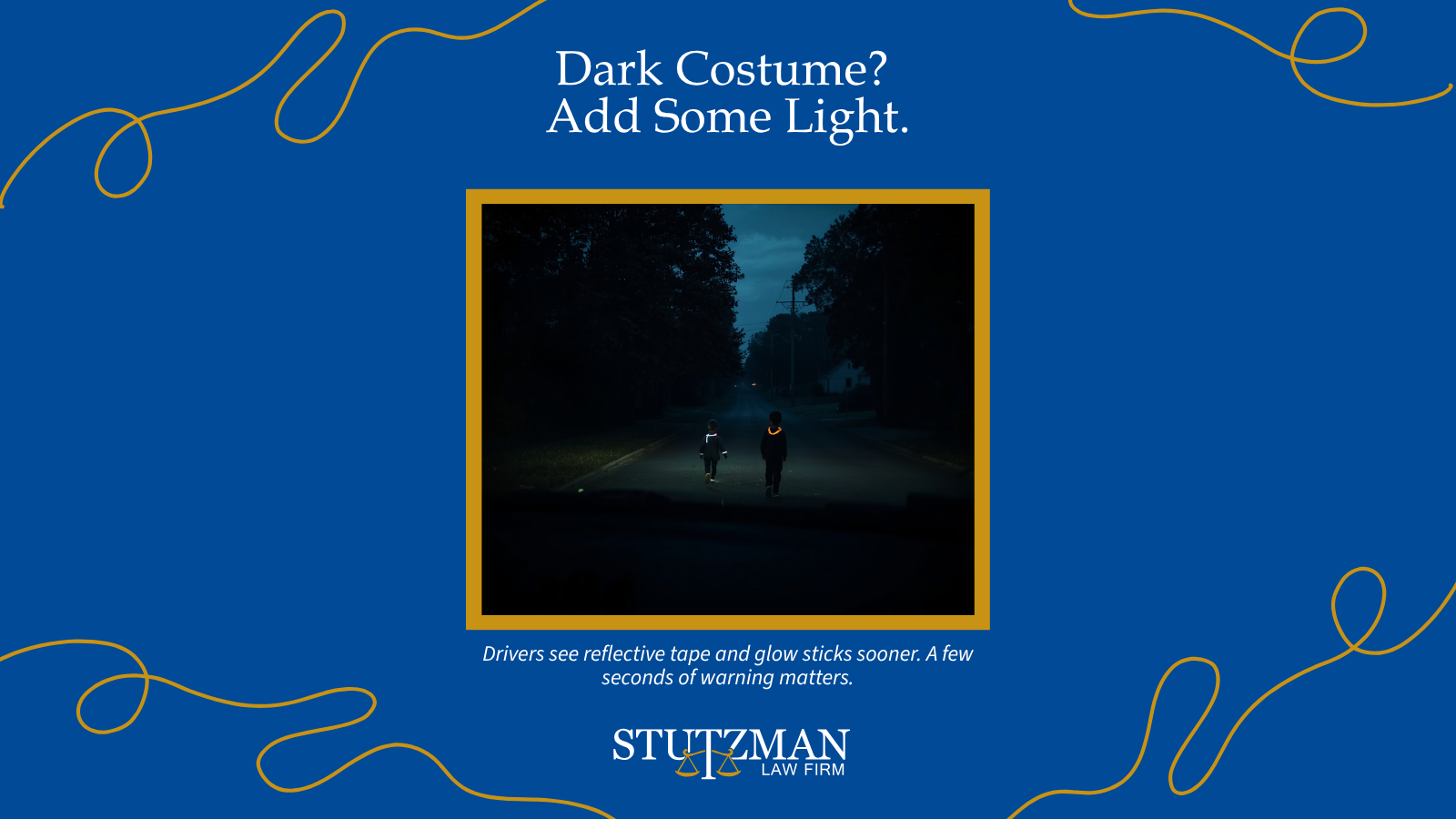
In pedestrian crash cases I've handled, one of the first things everyone wants to know is what the driver could see, and when. A child in dark clothing at dusk is hard to see. A child with reflective tape and a glow stick is a lot easier.
What Should I Add to My Child's Costume?
I'm not saying to give up the costume your kid has been planning since August. What I'm saying is to add a little light to it. The National Safety Council and other safety groups recommend a few simple steps:
1. Reflective tape on the front and back. A strip across the chest and back, plus a little on the treat bag. This catches headlights from either direction. It's cheap and usually in the same aisle as the costumes.
2. Glow sticks. A necklace or bracelet makes a child visible from the side. Kids love them, so this one doesn't take much convincing.
3. A flashlight for every child. It helps them see where they're stepping, and it gives drivers one more point of light to notice.
4. Bright colors where you can. If your child is set on being a ninja, that's fine. Just add the tape and the glow stick.
5. Face paint over masks. A mask can block a child's view of a car coming from the side. Nontoxic face paint or a well-fitted hat keeps their eyes clear.
6. A good fit. A costume that drags on the ground is a tripping hazard, especially when a child is crossing a street in a hurry.
What Else Can Parents Do on Halloween Night?
- Walk with young children. Kids under about 10 don't judge a car's speed and distance the way adults do.
- Cross at corners or crosswalks, not between parked cars. Teach kids to stop at the curb and look in every direction, including for cars turning in and backing out of driveways.
- Use the buddy system for older kids who go out without you. Agree on a route and a time to be home.
- Put the phone down while you walk, and teach older kids to do the same.
- Plan the route before dark, ideally through neighborhoods with sidewalks and good lighting.
What Should Drivers Do on Halloween?
If you're driving on Halloween evening, assume a child might step into the road.
- Slow down in residential areas, well below the posted limit if conditions call for it.
- Watch for kids in unexpected places: medians, curbs, and coming out from between parked cars.
- Back out of driveways slowly, and look twice.
- Put the phone away. Foregoing a two-second glance at a text could mean not hitting someone's child.
- Never drive impaired. If you'll be at a party, plan your ride home before you leave the house. If you see a driver who appears impaired, NHTSA recommends contacting law enforcement.
The Takeaway
Halloween should be one of the best nights of the year for a kid. Most of the danger comes down to one problem: drivers can't see children in time. Reflective tape, a glow stick, a flashlight, and a parent's hand at the curb go a long way toward fixing that.
Grab the tape or the glow stick when you buy the costume. You'll be glad you did.
If the worst does happen, insurance questions come quickly. We've written before about how medical bills get paid after a crash.
If you're taking the time to read this, you're either in this situation or you have real questions, and I'm happy to talk with you about it at no charge. Our number is (769) 208-5683. Feel free to reach out.
This article provides general safety information for educational purposes only. It is not legal advice and does not create an attorney-client relationship. Every situation is different. If you have questions about a specific situation, please consult an attorney.
Explore Topics
Written by
Ronald E. Stutzman, Jr.
Content creator and writer sharing insights and stories.